The Ultimate Guide to Video LED Walls: Specs, Costs, and Buying Strategies
If you walk into a modern corporate lobby, a luxury retail store, or an upscale entertainment venue, you are bound to see them: massive, vibrant, and completely seamless digital displays.
A video LED wall is no longer a futuristic luxury—it is the modern standard for high-impact visual communication.
But if you are tasked with buying, renting, or installing one, the technical jargon can quickly become overwhelming. What is the difference between an indoor and outdoor panel? How do you choose the right pixel pitch without blowing your budget? This guide cuts through the noise to tell you exactly what you need to know.
What is a Video LED Wall? (The Basic Principle)
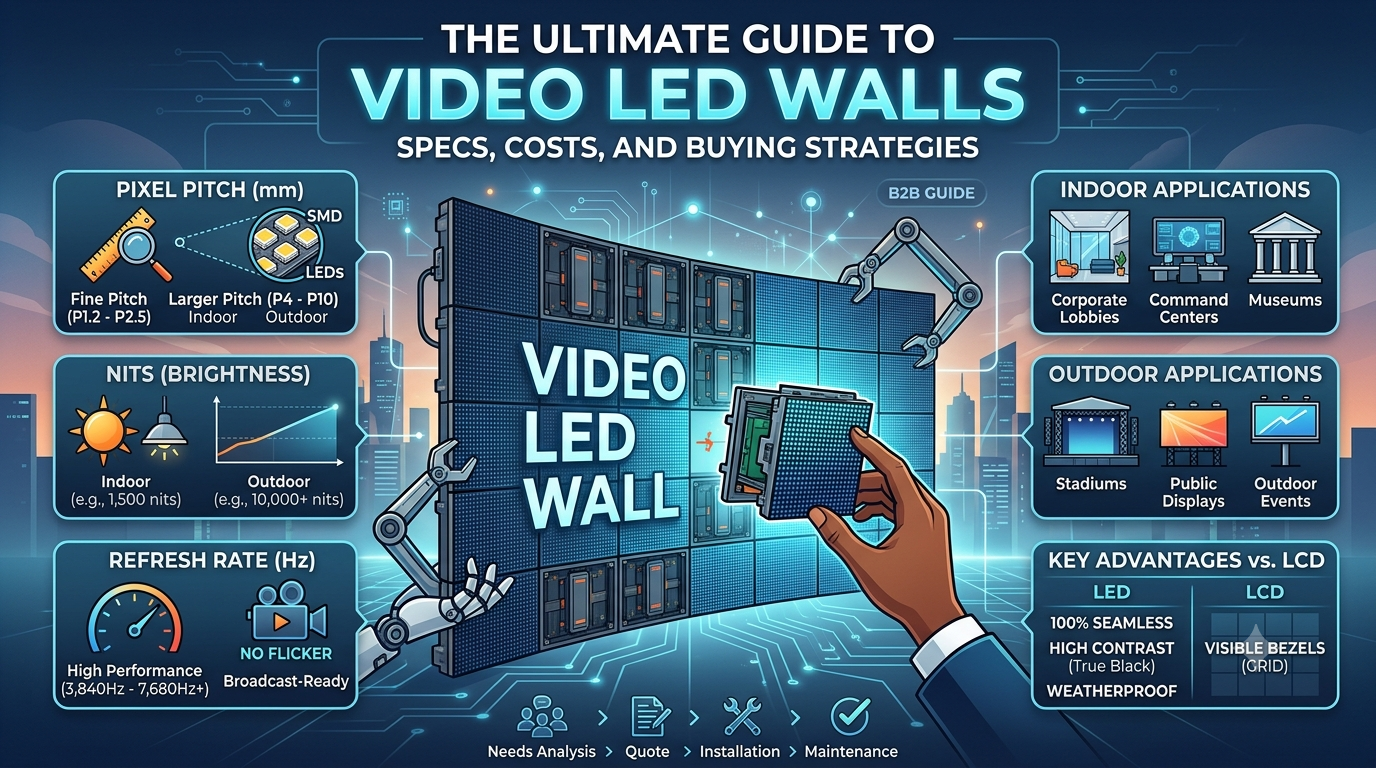
Unlike conventional LCD screens that rely on permanent backlighting passing through a liquid crystal layer, a true video LED wall is made up of self-luminous pixels. Each pixel consists of tiny light-emitting diodes (typically Surface-Mount Diodes, or SMDs). When an area of the screen needs to display pure black, those specific LEDs turn off completely. This drops power consumption to zero in that sector and creates a perfect, infinite black level—unlike LCDs, which often look milky gray under dark conditions. Because these walls are built out of individual tiles or “cabinets” that lock together perfectly, they can scale to any size or geometric shape without annoying plastic borders (bezels) interrupting the image.
The Big Three: Pixel Pitch, Nits, and Refresh Rate
When evaluating commercial vendors, your quote will hinge on three major technical metrics. Understanding these prevents you from overpaying for performance you do not actually need.
1. Pixel Pitch
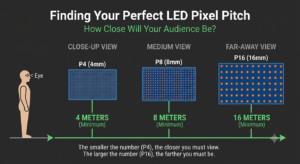
Pixel pitch is the distance (in millimeters) from the center of one pixel to the center of the next. It directly determines the resolution and the minimum viewing distance of your screen.
Understanding Pixel Pitch vs. Optimal Viewing Distance.
2. Nits (Brightness)
A “nit” is a unit of measurement for luminance (cd/m²). Ambient lighting conditions dictate exactly how many nits you require:
Indoor Conference Rooms: 600 to 1,500 nits is plenty. Anything brighter will cause eye strain.
Outdoor/Direct Sunlight: 5,000 to 10,000 nits are required to avoid getting completely washed out by the sun.
3. Refresh Rate
Measured in Hertz (Hz), this indicates how many times per second the display updates its image. Standard screens operate at 60 Hz, but high-end video LED walls boast refresh rates between 3,840 Hz and 7,680 Hz. This ultra-high speed ensures that if the wall is ever recorded on a camera or broadcast live, it remains completely flicker-free.
Tech Showdown: LED vs. LCD Video Walls
Many buyers get confused between a multi-screen LCD matrix and a true LED wall. Here is how they stack up side-by-side:
| Feature | True Video LED Wall | Traditional LCD Matrix |
| Bezels / Gaps | 100% Seamless | Visible grid lines between screens |
| Brightness | Exceptional (Up to 10,000 nits) | Limited (Usually under 700 nits) |
| Lifespan | ~100,000 hours (11+ years) | ~50,000 hours |
| Repairability | Modular (Replace a single tiny card) | Must replace the entire broken panel |
| Upfront Cost | Higher initial investment | Lower entry point |
Common Use Cases: Tailoring to Your Environment
The environment you choose heavily dictates your setup and total cost of ownership.
Indoor Corporate Settings
In corporate boardrooms, executive briefing centers, and luxury lobbies, fine-pitch indoor walls (typically P1.2 to P2.5) dominate. The focus here is entirely on crisp text readability and rich color accuracy for presentations and branding.
Outdoor Signage & Billboards
Outdoor installations are entirely different beasts. They use much larger pixel pitches (P6 to P10) because audiences see them from dozens of meters away. Crucially, they require heavy-duty, weatherproof metal cabinets with IP65 ingress protection ratings to keep out rain, dust, and humidity.
A 5-Point Checklist for B2B Buyers
Before signing a contract with an AV integrator, run through these essential parameters:
Calculate the True Viewing Distance: Do not pay a premium for a tight P1.2 pitch if your closest viewer is sitting 8 meters away in an auditorium. A P4 wall will save you thousands while looking identical at that distance.
Verify Front vs. Rear Accessibility: Front-accessible modules mean a technician can pull out a single faulty panel from the front with a magnetic tool in seconds. Rear accessibility requires a dedicated walkway behind the structure, eating up valuable real estate.
Factor in Power and HVAC: Large LED walls pull significant electrical loads and generate heat. Make sure your local facility team can supply the necessary power infrastructure and ventilation.
Match Content to Aspect Ratio: Most native video content is created in a 16:9 aspect ratio. Design your wall’s physical proportions to match this standard so your media does not look awkwardly stretched or letterboxed.
Evaluate Maintenance Agreements (SLA): LEDs fail over time. Ensure your vendor includes “batch-matching” spare diodes in your initial order, as buying replacement panels later from a different production batch will cause visible color mismatches.