IP CCTV Camera vs Analog CCTV: The Definitive Commercial Security Guide
When protecting a commercial asset, your surveillance system is your first line of defense. Deciding between an IP CCTV camera vs Analog CCTV is the very first technological crossroads every business operator faces.
Should you deploy a modern, intelligent digital network, or does old-school coaxial infrastructure still hold its ground? To help you make the right investment, let’s break down the hard facts, infrastructure realities, and real-world ROI of this classic security matchup.
The Core Difference: How They Work
To truly understand IP CCTV camera vs Analog CCTV performance, we have to look at how video data moves from the lens to your recording station.
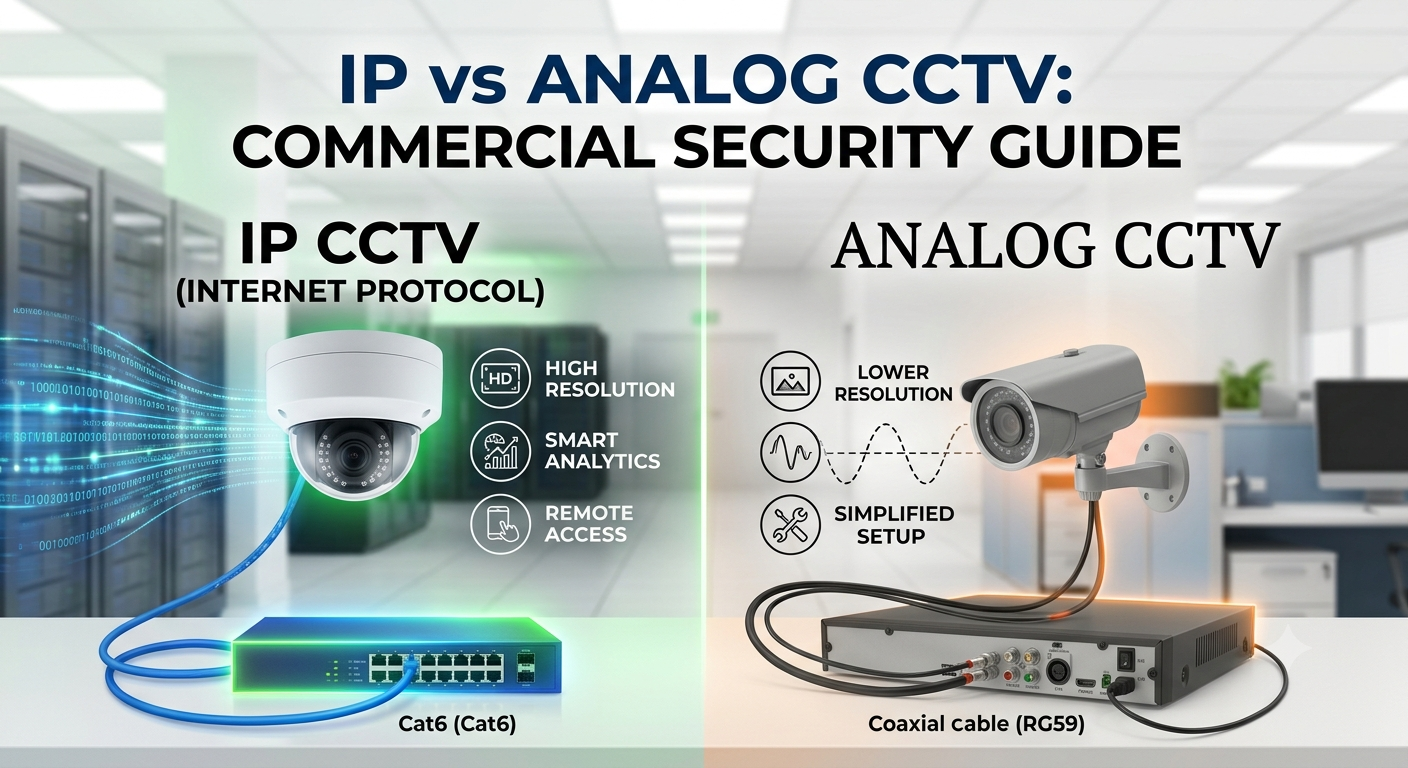
Analog CCTV Systems: These cameras capture an analog video signal and transmit it raw over bulky coaxial cables (RG59) to a Digital Video Recorder (DVR). The DVR is the “brain” that digitizes, compresses, and stores the footage. Each camera requires its own dedicated video cable, plus a separate wire for power.
IP (Internet Protocol) Systems: These are essentially mini-computers. They capture, digitize, and compress video directly inside the camera using modern codecs like H.265. The digital data is then sent over standard network infrastructure (Cat6 Ethernet cables) to a Network Video Recorder (NVR) or directly to cloud storage.
Head-to-Head Comparison
Let’s look at how the IP CCTV camera vs Analog CCTV matchup plays out across primary commercial benchmarks:
| Feature | Analog CCTV (HD-TVI / CVI) | IP CCTV Camera |
| Max Practical Resolution | Typically capped at 1080p | 4K (8MP), 12MP, and beyond |
| Cabling Requirements | Dual cables per camera (Coaxial + Power wire) | Single cable (Power over Ethernet / PoE) |
| Smart Analytics (AI) | Highly limited; processed slowly at the DVR level | On-camera edge AI (Facial recognition, object detection) |
| Scalability | Rigid; limited by physical ports on the DVR | Highly flexible; scale dynamically across switches |
| Remote Management | Clunky; requires manual network configuration | Seamless via encrypted apps, web portals, and cloud |
| Upfront Hardware Cost | Lower per-camera cost | Higher initial investment for cameras & PoE switches |
Commercial Pillars: Where the Battle is Won
1. Image Clarity and Practical Evidence
In a commercial environment, a blurry image is useless. If a camera cannot clearly resolve a shoplifter’s face, a license plate at your loading dock, or an employee incident, it is a wasted asset.
IP Cameras easily hit native 4K. Because the footage is compressed digitally at the edge, it retains sharp borders. This allows security teams to use digital zoom on recorded footage without the image immediately breaking down into unreadable pixels.
Analog Cameras have improved, but they suffer from progressive signal degradation over long cable runs. They also struggle heavily with wide dynamic range (WDR) environments—like a glass retail entrance with harsh sunlight blinding the background.
2. Installation Complexity & Total Cost of Ownership (TCO)
Do not let the cheaper retail price of an analog camera fool you. When analyzing the installation costs of an IP CCTV camera vs Analog CCTV setup, labor is the hidden variable.
Analog forces you to pull two lines (Coax + Power) back to the central station for every single camera. If you have a 32-camera system, that is 64 cable runs.
IP utilizes PoE (Power over Ethernet). A single Cat6 cable delivers video transmission, audio, power, and pan-tilt-zoom controls simultaneously. Furthermore, you can run multiple local IP cameras into a single PoE network switch inside a warehouse, then run just one main network cable back to the NVR. This slashes labor and raw material costs by half.
3. Edge AI and Automated Security
Modern commercial security cannot rely solely on a human guard staring at dozens of monitors. It requires automated, proactive alerts.
IP cameras feature powerful onboard processors capable of running highly precise AI analytics. They filter out false alarms (like shadows or stray animals) and only ping your phone or security desk for verified events: line-crossing, vehicle classification, facial recognition, or license plate retrieval.
Analog systems relegate analytics to the central DVR. The processing power is choked, meaning you are often stuck with basic pixel-change motion alerts that fire off every time a light flickers.
The Verdict: Which System Should You Choose?
Your final decision on an IP CCTV camera vs Analog CCTV should ultimately align with your scaling plans and physical layout.
Go with IP CCTV if you are building a new facility, require high-definition details (like monitoring cash registers), want to utilize proactive AI alerts, or need easy remote cloud access.
Go with Analog CCTV only if you are on a tight budget and are moving into a building that already has functional, high-quality legacy coaxial cables pre-installed.
Related Posts
Commercial LED video wall display dealer in Jorhat
Commercial LED Video Wall Display Dealer in Jorhat | Eastern Networks Looking for a commercial LED video wall display dealer
Biometric attendance system authorized dealer in Jorhat
Looking for a biometric attendance system authorized dealer in Jorhat? Eastern Networks provides biometric solutions, installation and technical support. Biometric