
Protecting your property isn’t just about having a loud noise that wakes up the neighbors; it’s about choosing the right “brain” for your building’s safety. Whether you’re managing a cozy coffee shop or a sprawling industrial complex, the types of fire alarm systems you choose can be the difference between a minor incident and a total loss.
In this guide, we’ll break down the different systems available today so you can make an informed decision—without needing a degree in fire science.
What are the Main Types of Fire Alarm Systems?
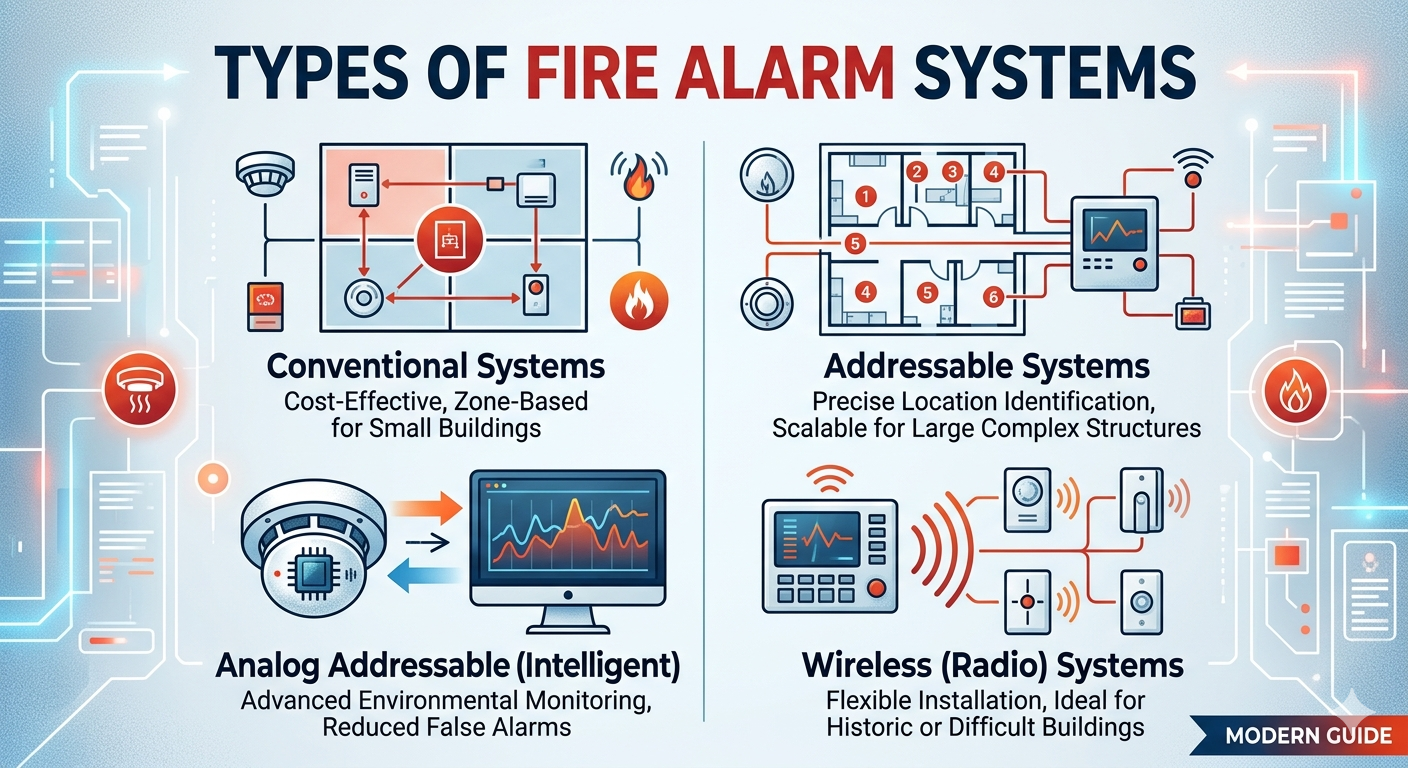
Fire alarm systems have evolved from simple “bells and whistles” to highly sophisticated networks that can tell you exactly which room has a smoke issue. Generally, these systems fall into four main categories.
1. Conventional Fire Alarm Systems
Conventional systems are the “old school” but reliable choice. They work by dividing a building into zones. If a detector in Zone 2 (say, the kitchen) goes off, the control panel tells you there’s a fire in “Zone 2.”
Best for: Small businesses, retail shops, and simple layouts.
Pros: Cost-effective and straightforward to install.
Cons: It won’t tell you the exact room; it only points you to the general zone.
2. Addressable Fire Alarm Systems
This is the modern standard for most commercial properties. Unlike conventional systems, every single device (smoke detector, heat sensor, pull station) has its own unique “address.”
If a sensor in Room 402 on the 4th floor detects smoke, the panel displays exactly that: “Smoke Detected: Room 402.” This allows emergency responders to bypass the guessing game and head straight to the source.
Best for: Large office buildings, hotels, and schools.
Pros: Precise location tracking and easier maintenance (the system tells you which specific head needs cleaning).
Cons: Higher initial hardware cost.
3. Analog Addressable Fire Alarm Systems
Often confused with standard addressable systems, “Analog Addressable” (or Intelligent) systems are the overachievers of the group. These systems don’t just wait for a “fire/no fire” signal; they constantly monitor the environment.
They analyze data like smoke levels and heat fluctuations to determine if a threat is real or just a burnt piece of toast. This significantly reduces false alarms, which is a win for everyone’s eardrums and sanity.
4. Wireless (Radio) Fire Alarm Systems
No wires? No problem. Wireless systems use secure radio frequencies to communicate between sensors and the control panel. They offer the same level of protection as addressable systems but without the need for miles of cabling.
Best for: Historic buildings, museums, or places where drilling holes in walls is a “no-go.”
Pros: Quick installation and minimal structural disruption.
Cons: Requires more frequent battery checks and carries a higher price tag for the tech.
Comparison of Fire Alarm System Types
To help you visualize the differences, here is a quick breakdown:
| Feature | Conventional | Addressable | Wireless |
| Precision | Zone-level only | Device-specific | Device-specific |
| Wiring | Heavy cabling required | Loop cabling | Little to no wiring |
| Ideal For | Small units/shops | Large complexes | Historic/Renovated sites |
| Cost | Lowest | Moderate | Highest |
| Reliability | High | Very High | High (Battery dependent) |
Which System is Right for You?
Choosing between these types of fire alarm systems usually comes down to three factors: Budget, Building Size, and Risk Level.
If you have a small, single-story shop: A Conventional system is likely all you need to stay compliant and safe.
If you manage a multi-story building: You absolutely want an Addressable system to ensure quick evacuation and targeted fire suppression.
If you have a complex layout with high false-alarm risks: Invest in an Analog Addressable (Intelligent) system to filter out the noise.
Frequently Asked Questions
What is the difference between conventional and addressable fire alarms?
A conventional system identifies a general area (zone) where a fire is detected, while an addressable system identifies the specific device and room triggered.
Are wireless fire alarm systems reliable?
Yes. Modern wireless systems use encrypted radio signals and are fully compliant with safety standards like NFPA 72 or BS 5839, provided they are maintained properly.
How often should fire alarm systems be tested?
Most jurisdictions require a professional inspection at least once a year, though monthly “user tests” of pull stations and sirens are highly recommended.
Related Posts
equipment for smart classroom
Share the Post: 10 Essential Equipment for Smart Classroom: The 2026 Ultimate Guide The landscape of Indian education has shifted.
biometric attendance machine price
Biometric Attendance Machine Price List 2026 Share the Post: The “sticker price” of a device varies significantly based on the