
The Ultimate Guide to Commercial PA Systems in Northeast India
Whether you are managing a bustling school in Guwahati, a multi-story corporate facility, or a high-traffic industrial warehouse in the Northeast, clear communication isn’t just a convenience—it’s operational infrastructure.
A well-designed PA system (Public Address system) ensures that your announcements, emergency alerts, and background music reach every corner of your property with perfect acoustic clarity. However, choosing the right setup can be challenging due to architectural differences, environmental factors, and shifting technologies.
This guide breaks down exactly how a modern public address system works, the core components you need, and how to choose the perfect system for your space.
What is a PA System and How Does It Work?
At its core, a PA system is an electronic sound reinforcement system that amplifies a human voice, recorded audio, or instruments so they can be clearly heard over a large area or noisy environment.
To achieve uniform sound distribution without creating deafening “hotspots” or muddy “dead zones,” audio signals must flow through a precise sequence of components.
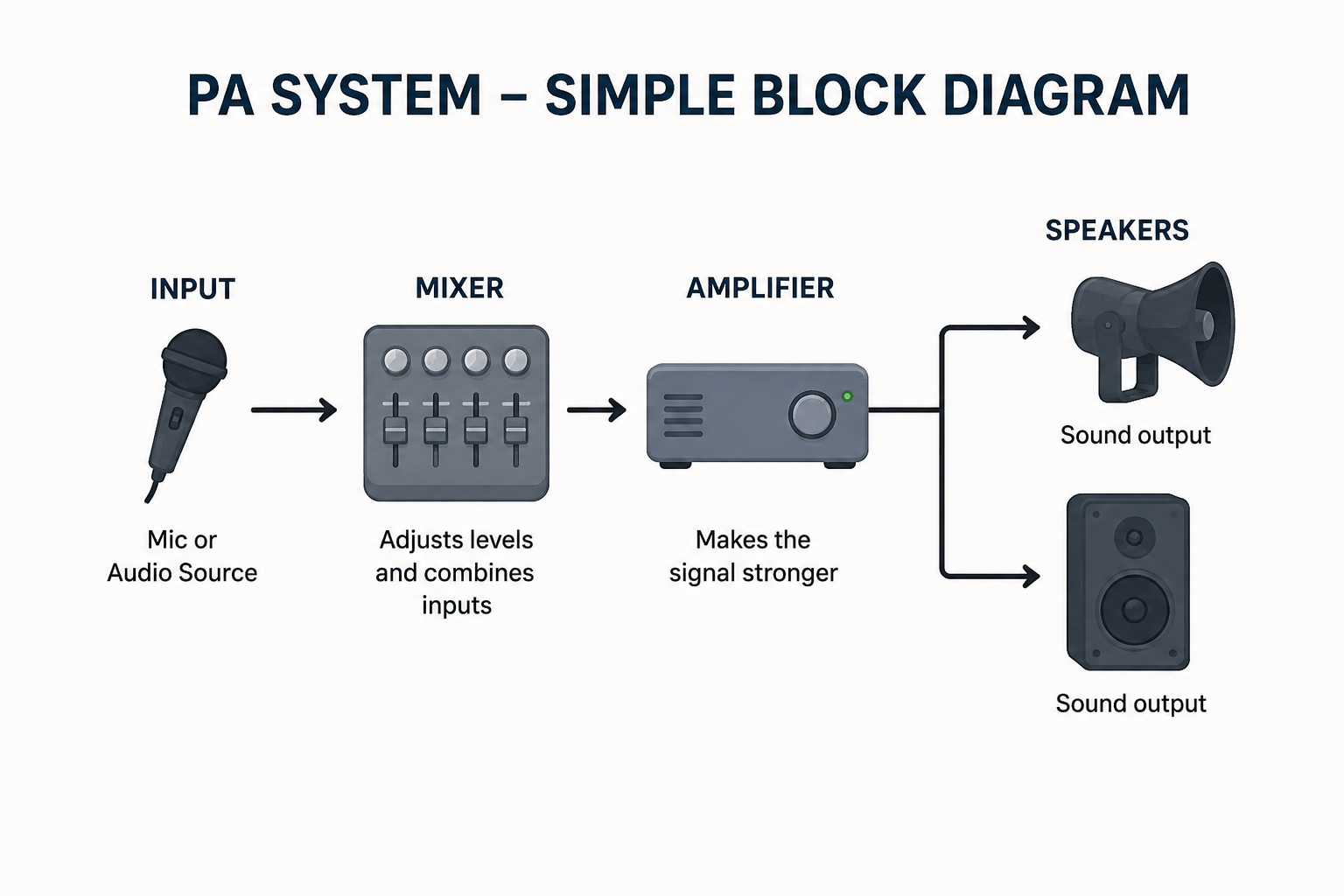
As shown in the block diagram above, a functional commercial setup relies on a clean signal path:
Input Devices: Microphones (paging consoles, desktop mics, or wireless systems) or media players convert physical sound waves into weak electrical signals.
Mixers & Audio Processing Units: These units combine multiple audio inputs, balance the volume levels, and apply equalization (EQ) to remove background hums and improve speech intelligibility.
Amplifiers (and Pre-Amplifiers): The processed low-voltage signal is boosted by an amplifier to a level powerful enough to drive the output hardware.
Loudspeakers: Finally, ceiling speakers, wall-mounted cabinets, or outdoor horn loudspeakers convert that electrical energy back into clear, uniform sound waves for the audience.
2026 Technology Shift: Analog vs. Networked IP PA Systems
If you are upgrading your facility, you will face a fundamental technological choice: traditional analog lines or modern, network-based IP systems.
Historically, analog systems required miles of dedicated copper speaker cables. Today, modern infrastructure relies heavily on Networked IP PA Systems. These systems connect directly to your existing IT network infrastructure using standard LAN cables.
The Network Advantage: Networked systems allow you to assign independent digital zones across your property via software. For example, you can page a single floor without disturbing the rest of the building, schedule automated announcements, and monitor the health of every individual speaker remotely from a single dashboard.
Choosing the Right System for Your Environment
Different spaces present unique acoustic and environmental challenges. A quiet school corridor requires a completely different layout than a loud manufacturing plant.
When evaluating a system, engineers look closely at the Signal-to-Noise Ratio (SNR)—the difference in decibels between the PA system’s audio output and the ambient background noise. To maintain clear speech comprehension, your system needs to stay comfortably above the room’s baseline noise level.
| Facility Type | Average Ambient Noise | Recommended PA Speaker Type | Key Acoustic Goal |
| Schools & Colleges | 40 – 50 dB (Quiet corridors) | Flush-mount Ceiling Speakers | High speech intelligibility; multi-zone paging for individual classrooms. |
| Corporate Offices | 50 – 65 dB (Normal layout) | Minimalist Pendant or Ceiling Speakers | Low-latency background music and seamless emergency evacuation routing. |
| Warehouses & Industrial Sites | 75 – 90 dB+ (Very Noisy) | High-output Directed Horn Speakers | Cutting through heavy machinery noise with high-gain, weatherproof hardware. |
| Outdoor Public Spaces | Variable | Weatherproof, Explosion-protected Speakers | Long-throw sound projection capable of resisting high humidity and heavy rainfall |
Why Local Expertise Matters in Northeast India
Designing a reliable audio layout isn’t just about buying premium hardware; it requires a deep understanding of local realities.
Northeast India presents unique environmental factors—such as high ambient humidity and intense monsoon seasons—that can degrade cheap, exposed audio components over time. Furthermore, historic structures or regional architectural styles often require custom acoustic adjustments to prevent echoes and sound reflections.
At Eastern Networks, we provide end-to-end commercial audio and public address infrastructure tailored to the specific needs of enterprises across Northeast India. From initial acoustic site surveys and precise zoning design to professional installation and long-term maintenance, our team ensures your communication infrastructure remains future-proof, crystal clear, and completely dependable.
Ready to optimize your facility’s audio infrastructure? Contact Eastern Networks today for a comprehensive acoustic consultation.
Related Posts
Smart classroom solutions for schools in Guwahati
Smart Classroom Solutions for Schools in Guwahati | Eastern Networks Explore smart classroom solutions for schools in Guwahati. Eastern Networks
Commercial LED video wall display dealer in Jorhat
Commercial LED Video Wall Display Dealer in Jorhat | Eastern Networks Looking for a commercial LED video wall display dealer